

Why Your GBP Is the Highest-Leverage Asset You Own
Think about the last time you needed a plumber, an electrician, or someone to fix your AC before a heatwave. You almost certainly didn't type a company name into Google. You searched "plumber near me" or "AC repair [your city]," glanced at the three map pack results, checked the star ratings, and called the top one. That entire decision happened before your website was ever opened — sometimes it never gets opened at all.
That's the reality for home service businesses today. Local searches with clear intent to call, visit, or book now make up nearly half of all Google queries, and the map pack — not the organic listings below it — is where almost all of that traffic converts. A fully built-out, actively managed Google Business Profile (GBP) is the single asset with the most direct line to your phone ringing.
We work with plumbers, electricians, HVAC companies, and roofers every week whose biggest visibility problem isn't their website — it's a half-finished, rarely-touched GBP that's quietly losing them the map pack every single day. This guide covers exactly what to fix, in order of impact.
The Three Pillars Google Actually Ranks On
Google has said for years that local ranking comes down to three things: relevance, distance, and prominence. That framework still holds in 2026, but each pillar now carries more sub-signals than it used to.
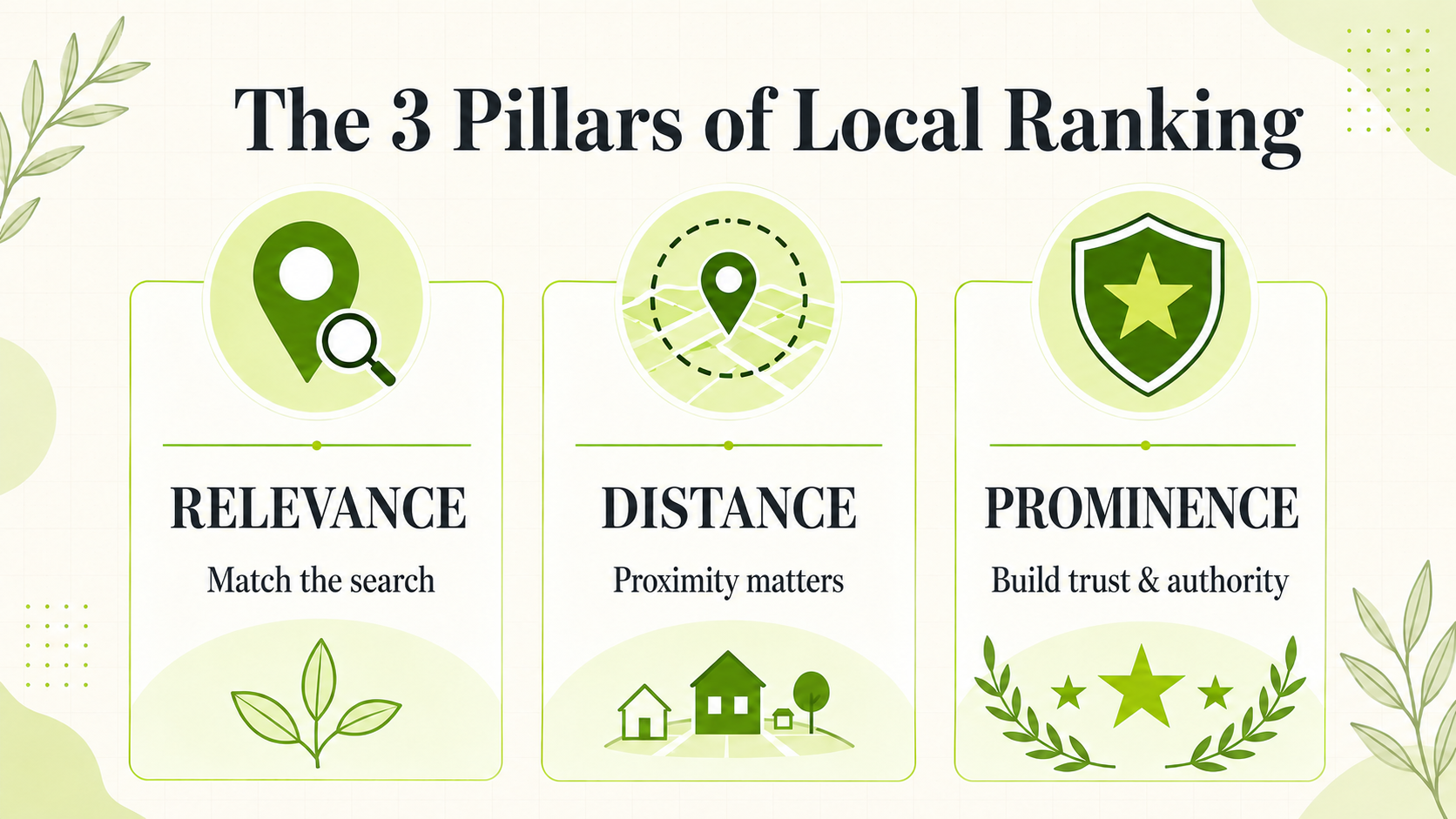
- Relevance — how well your profile matches what the searcher typed. Your primary category, additional categories, services list, and description text all feed this directly.
- Distance — how close your service address (or service area) is to the searcher. You can't control this one directly, but listing every legitimate service area as its own entry helps you show up for more specific "near me" queries.
- Prominence — how well-known and trusted Google considers your business, based on review volume and quality, citations, backlinks, and behavioral signals like click-through and call rate.
Of the three, relevance and prominence are entirely within your control. That's where the rest of this guide is focused.
Claiming and Verifying Your Profile the Right Way
If you haven't already, claim your profile directly through Google Business Profile's official help center rather than a third-party "we'll set it up for you" service that keeps admin access. Verification is usually done by postcard, phone, or email depending on your business category and history.
A few things matter more than people expect at this stage:
- Your business name on the profile must match your real-world signage and legal name exactly — no keywords stuffed in ("Smith Plumbing" not "Smith Plumbing – 24/7 Emergency Plumber Nearby").
- Only one listing per business location. Duplicate or abandoned listings from a previous owner or old marketing agency actively hurt you and should be merged or removed.
- Make sure the account owner is you or someone at your company, not the web developer who built your site five years ago and has since disappeared.
Category Selection: The Biggest Lever Trades Get Wrong
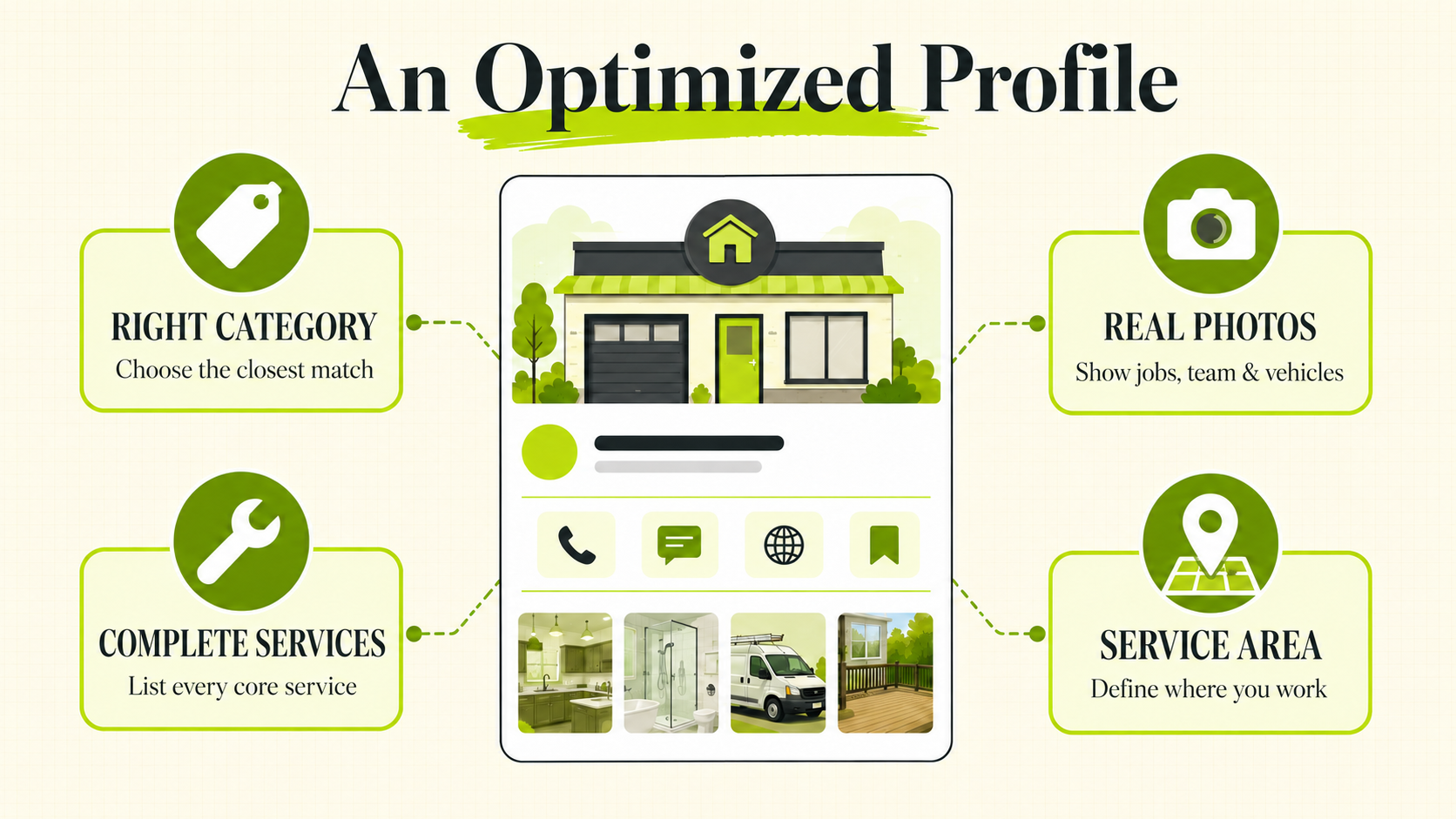
Primary category consistently ranks as the single most influential factor in local pack visibility, according to industry-wide ranking factor surveys from firms like BrightLocal and Whitespark. Yet it's the field most trade businesses set once and never revisit.
Two rules to follow:
- Pick the narrowest accurate category, not the broadest one. "Plumber" beats "Contractor." "HVAC Contractor" beats "General Contractor." Narrow categories match narrow, high-intent searches.
- Stack relevant additional categories. A roofer who also does gutter installation and storm damage repair should add those as secondary categories, not just mention them in the description.
Review your category selection every quarter. Google periodically adds new, more specific categories, and switching to a newer, tighter match can meaningfully lift your visibility for the exact services you actually perform.
Writing a Description and Services List That Ranks
Every text field on your profile is a relevance input Google can match against a search query — treat the business description and services list as on-page SEO, not marketing copy.
Compare these two descriptions for the same electrician:
- Weak: "Your trusted local electrician for all your needs."
- Strong: "Licensed residential and commercial electrician serving [City] and surrounding areas — panel upgrades, EV charger installation, ceiling fan wiring, emergency electrical repair, and whole-home rewiring."
The second version matches far more real search queries because it names the actual services someone types into Google. Do the same inside the Services section of your profile — list every individual service as its own line item rather than one vague catch-all category.
Photos, Videos, and the "Real Photo" Signal
Profiles with recent, real photos of actual jobs, vehicles, and crew consistently out-convert profiles using stock imagery or a single logo. Google can distinguish between the two, and searchers definitely can.
- Upload photos weekly, not once during setup. A truck at a real job site, a before/after of a finished repair, a technician in branded uniform.
- Add a short video walkthrough of a recent job if you can — video listings get disproportionate engagement relative to how few competitors bother uploading any.
- Avoid stock photos and generic "handyman" clip art entirely. They read as low-trust to both Google's systems and to homeowners comparing three profiles side by side.
Reviews: Volume, Velocity, and Review Justification
Reviews influence both ranking and conversion, and in 2026 the specific wording inside a review matters almost as much as the star rating. When a customer mentions the actual service by name — "replaced our water heater," "fixed a breaker panel," "re-shingled the roof after the storm" — Google connects that text to your business as a trust signal for that exact service. Industry practitioners increasingly call this a review justification signal.
A simple, repeatable review request process matters more than any single tactic:
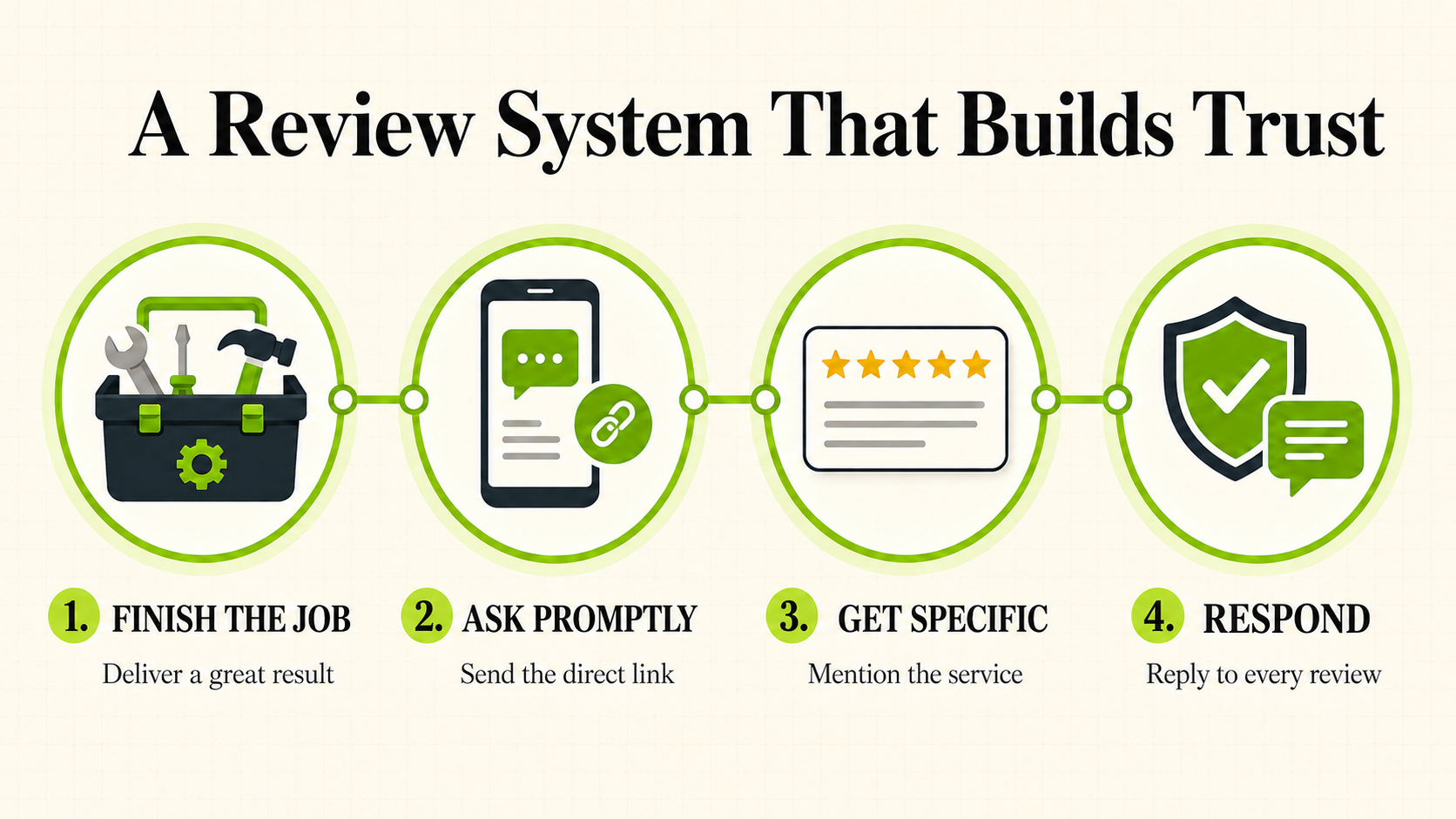
- Ask within 24 hours of the job being completed, while the experience is fresh.
- Send a direct link to your review form — remove every point of friction.
- Prompt (don't script) the customer to mention the specific service performed.
- Respond to every review, positive or negative, within a few days. A thoughtful, non-defensive response to a negative review often does more for trust than the review itself did damage.
For a deeper look at why relying on third-party lead marketplaces instead of building this kind of owned visibility quietly erodes your margins, see how RiseOnX helps trades build that visibility from the ground up.
Posts and Q&A: Signals Most Competitors Ignore
Google Posts are a minor direct ranking factor, but a strong indirect one — they signal an actively managed profile and give you extra keyword-rich, indexed content tied directly to your listing.
- Post weekly: a completed job, a seasonal offer, an availability update ahead of a busy season.
- Seed your own Q&A section with the questions you actually get asked on the phone — service area, emergency availability, financing options — and answer them yourself before a competitor or a random user does it inaccurately.
Structured Data: Helping Google and AI Search Understand Your Business
Your website should reinforce what your GBP already says, using schema markup Google (and increasingly AI search assistants) can read directly. At minimum, a home service business's site should include:
- LocalBusiness / specific sub-type schema (Plumber, Electrician, HVACBusiness, RoofingContractor) matching your GBP category.
- Service schema for each core service, ideally backed by its own dedicated page rather than one generic "services" page.
- Review or AggregateRating schema reflecting your real, current review data — never fabricated.
- FAQPage schema on pages that answer real customer questions, structured the same way this article's FAQ section is below.
Dedicated location and service pages, each carrying its own structured data, consistently outperform a single dense homepage trying to rank for everything at once.
Common Mistakes That Get Trades Filtered
- Keyword-stuffed business names ("Mike's Plumbing – Best Emergency Plumber [City]") — this now actively triggers policy enforcement and can get a listing suspended entirely, not just penalized.
- Multiple listings at one address, often left over from a previous owner or a past marketing agency, splitting your review signal across profiles.
- Fake or incentivized reviews, which are increasingly easy for Google to detect and can result in review removal or profile suspension.
- A service-area business listed with a public storefront address when customers are actually served at their location, not yours — this creates a proximity mismatch Google penalizes.
- Letting the profile go stale — no new photos, no posts, no review responses for months at a time, which weakens the engagement signals competitors are actively building.
A 30-Day Optimization Checklist
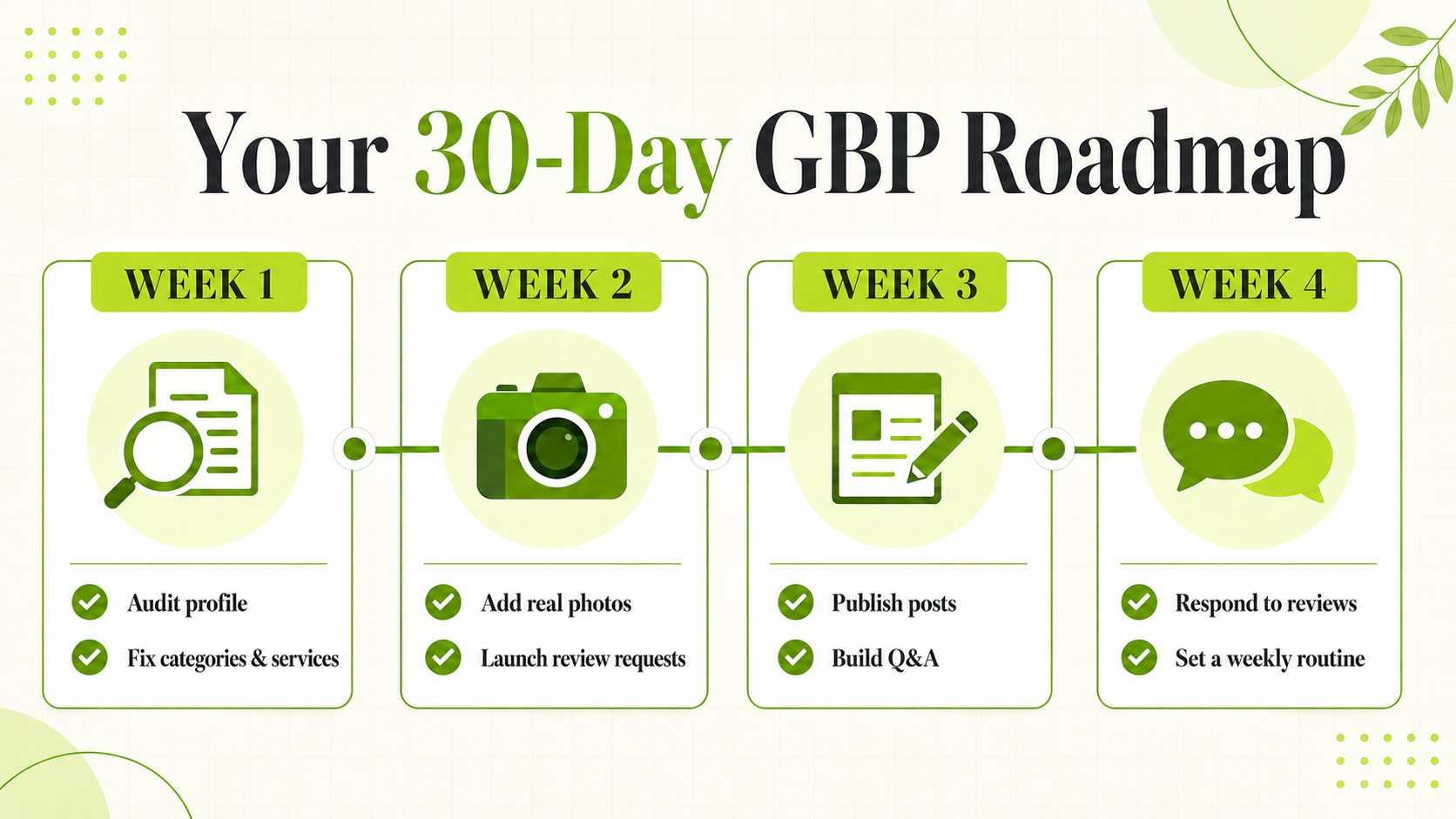
- Week 1 — Audit: verify NAP consistency, remove duplicate listings, confirm primary and additional categories are the narrowest accurate match.
- Week 1 — Rewrite the business description and rebuild the services list as individual line items.
- Week 2 — Upload a batch of real, recent job photos and one short video walkthrough.
- Week 2 — Set up a simple review request workflow triggered right after job completion.
- Week 3 — Publish your first three Google Posts and seed five real Q&A entries.
- Week 3 — Add or update LocalBusiness and Service schema on your website to match your GBP exactly.
- Week 4 — Respond to every open review, then set a recurring weekly reminder for posts, photos, and review follow-up going forward.
Want this done for you instead of squeezed into your week?
This is exactly the work we handle for plumbing, electrical, HVAC, and roofing companies every day. See how it fits your business on a free strategy call.
Book Free CallFAQ
How long does it take for a Google Business Profile to rank after optimization?
Most home service businesses see movement within 4 to 8 weeks of a serious optimization pass, provided reviews keep coming in and the profile stays active with posts and photos. Full map pack dominance in a competitive metro area usually takes 3 to 6 months of consistent work.
Can I change my primary Google Business Profile category myself?
Yes. Any verified owner or manager can update the primary and additional categories directly from the Google Business Profile dashboard under the Business Information tab. Changes typically reflect in search results within a few days.
Do Google Business Profile posts actually affect rankings?
Posts are a minor direct ranking factor but a strong indirect one. They keep your profile active, which feeds engagement signals, and they give you extra keyword-rich content tied to your listing without touching your website.
How many Google reviews does a trade business need to compete?
There's no fixed number, but in most metro markets a plumbing, HVAC, electrical, or roofing business needs at least 40 to 60 recent, keyword-rich reviews with a 4.7+ average to consistently sit in the top three map pack results.