

Two plumbing companies in the same metro area, roughly the same revenue, roughly the same margin, went to market within four months of each other last year. One sold for a materially higher multiple than the other. Same trade, same city, same size. The financials, on paper, were nearly interchangeable.
The difference sat in a place almost nobody was trained to look during diligence: their Google Business Profiles. One had 640 reviews, a third of them from the last six months, mentioning technicians by name and the specific jobs performed. The other had 90 reviews, most of them three years old, half of them thanking "the owner" by name for showing up personally.
To a buyer, that's not a marketing footnote. That's a readable signal about whether the revenue survives the transition — read on to see exactly how that gets priced.
What Changed for Buyers in 2026
For most of the last decade, a Google review count was treated as a top-of-funnel marketing metric — something that helped a business win the next job, not something that showed up in a valuation model. That's no longer accurate, and the shift didn't happen because of some new algorithm. It happened because buyers got better at pricing risk.
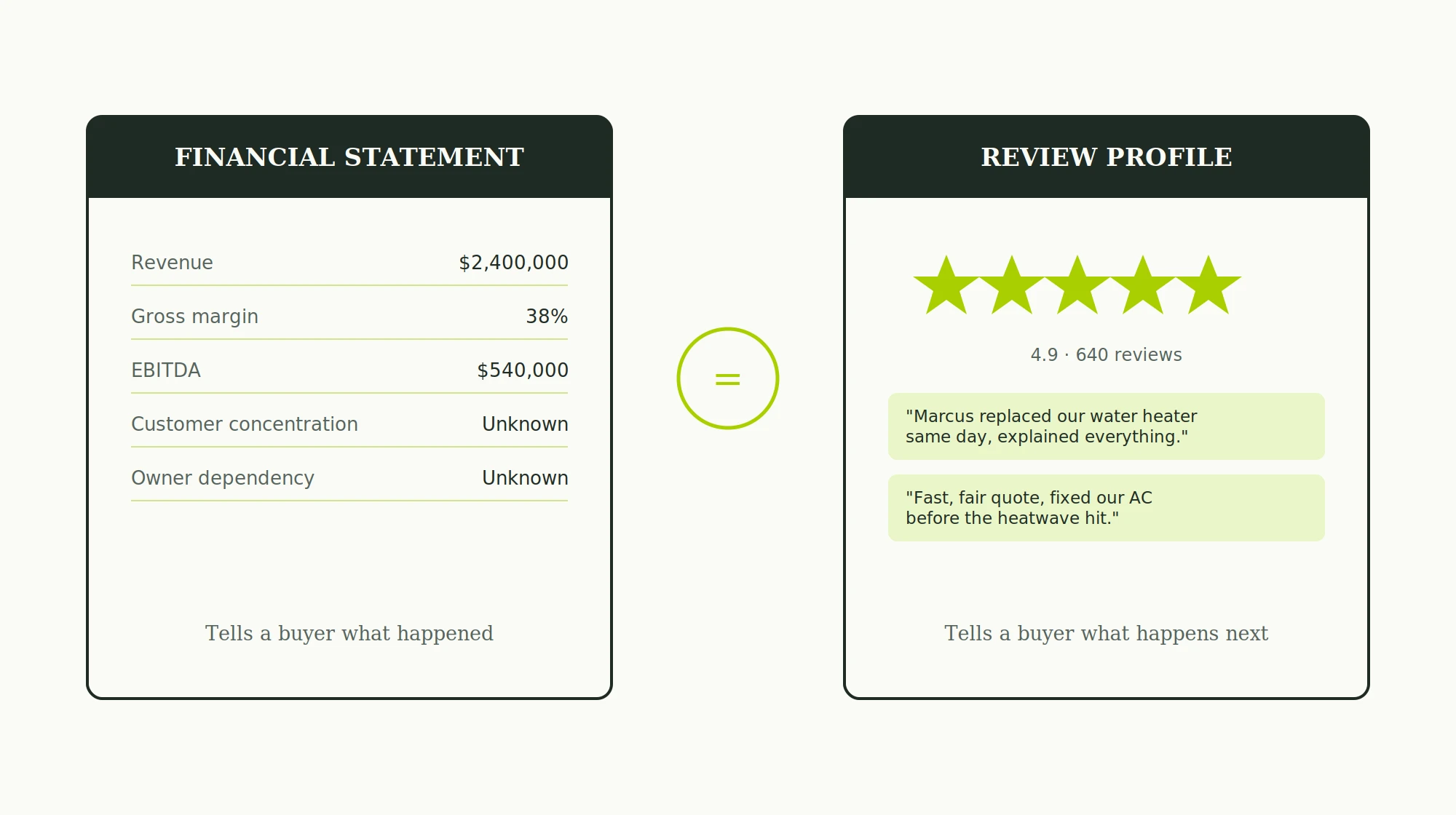
When private equity roll-ups, franchisors, and independent operators evaluate a home service business today, the central question isn't "was this profitable." It's "does the revenue keep showing up once the current owner stops answering their own phone." A financial statement answers the first question well. It answers the second one poorly. A live, current, well-managed review profile is one of the few artifacts a buyer can inspect in five minutes that speaks directly to durability.
The Three Layers of Diligence Buyers Now Run
Most owners assume diligence is one event — an accountant goes through the books. In practice, buyers of home service businesses now run three distinct passes, often in this order:
- The five-minute scan. Before a call is even booked, a buyer or their analyst pulls up the Google Business Profile: star average, review count, most recent review date, category, and photos. This decides whether the business gets a second look at all.
- The financial pass. The traditional review — P&L, tax returns, customer concentration, recurring vs. one-time revenue.
- The reconciliation pass. This is the newer layer. The buyer checks whether the story the reviews tell matches the story the financials tell. Claimed job volume that doesn't match review volume, or a revenue "growth story" with a flatlining review count, is where deals get repriced or walked away from.
Most sellers prepare thoroughly for layer two and never think about layers one or three until a buyer brings it up mid-negotiation — at which point it's a lot harder to fix. This is exactly the kind of gap we help close through ongoing local SEO and review management, well before a sale is even on the table.
What a Review Profile Signals That a P&L Can't
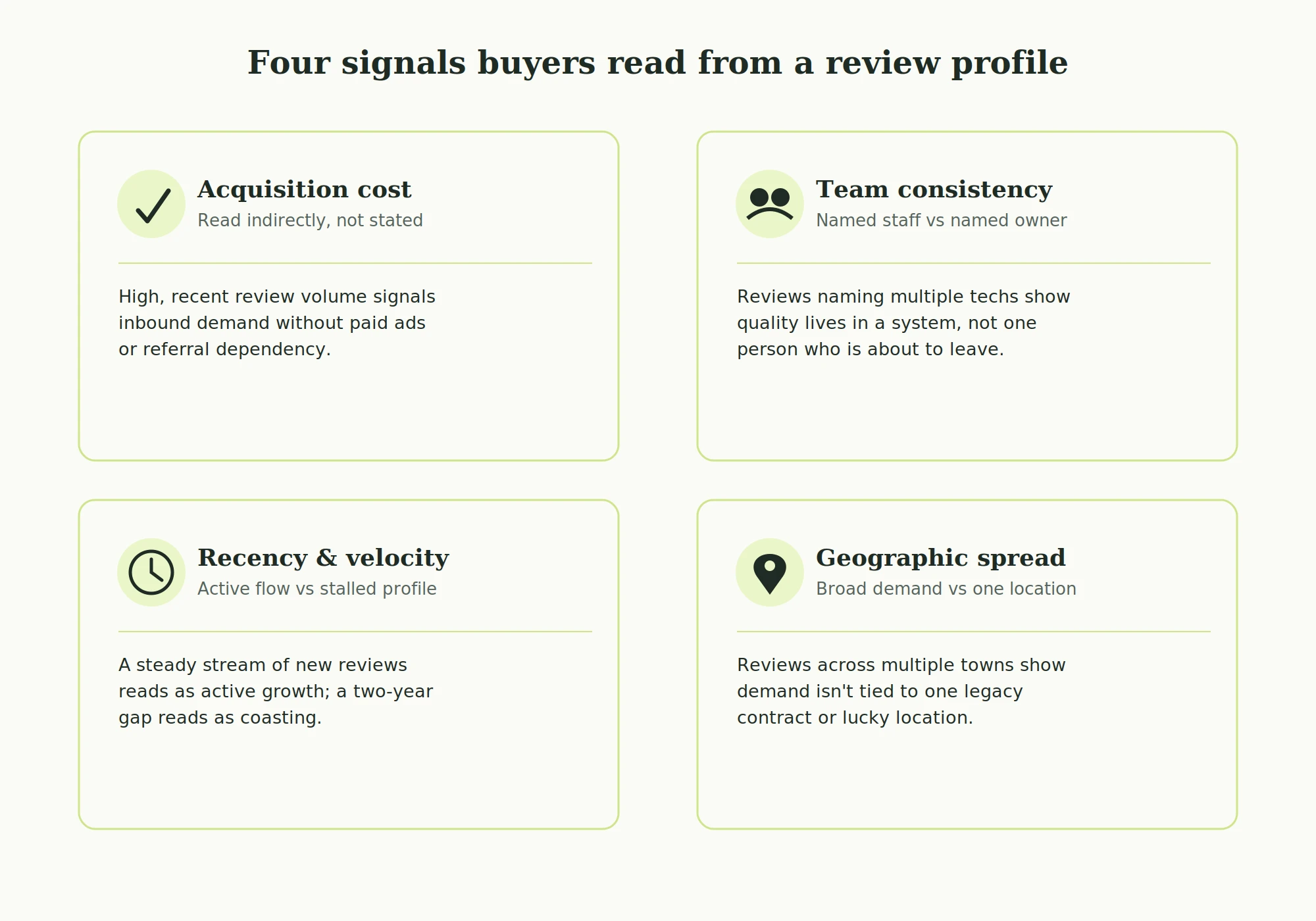
There are four specific things an experienced buyer is reading out of a Google profile, and each maps to a real financial risk they'd otherwise have to estimate blind.
1. Customer acquisition cost, indirectly
A business with hundreds of recent, organic reviews is visibly generating inbound demand without buying every lead. A business with a thin, aging review count looks dependent on paid ads, a referral partner, or the owner's personal Rolodex — all of which are considerably harder to transfer to a new owner than a search-visible brand.
2. Service consistency across the team
Reviews that name different technicians, across different service lines, tell a buyer the quality lives in a system, not one person's head. Reviews that all mention the owner by name tell a buyer the opposite, and set up the "owner name problem" covered further down.
3. Recency and velocity
A steady, current flow of new reviews reads as an active, growing business. A profile that peaked two years ago and has gone quiet — even sitting at 4.9 stars — reads as a business coasting on old momentum, and buyers discount for that.
4. Geographic and category saturation
Reviews mentioning multiple neighborhoods or towns, tied to a tightly matched service category, tell a buyer the demand is broad-based rather than concentrated around one lucky location or one legacy contract that might not renew under new ownership.
The Numbers Behind the Premium
Business brokers and M&A advisors working in home services increasingly describe a consistent pattern, even where the exact multiple varies by trade and region: businesses with strong, current review profiles tend to close at a noticeably higher multiple than comparable businesses with weak or stagnant ones — all else being equal. The gap isn't explained by revenue or margin. It's explained by perceived risk. A buyer paying a multiple of earnings is really paying for confidence those earnings continue, and a healthy review profile is one of the cheapest, most visible ways to demonstrate that confidence before a single financial document changes hands.
Note: figures above describe directional industry patterns reported by brokers and advisors, not a fixed formula — they'll vary by trade, region, and deal size.
Red Flags That Discount a Sale Price
None of these are dealbreakers in isolation. In aggregate, they shift a buyer's confidence — and confidence is exactly what sets the multiple, long before a single line of the P&L is disputed.
The "Owner Name" Problem — Why Personal Goodwill Scares Buyers
This is the single most common issue brokers flag, and the least understood by sellers. A profile full of reviews like "John came out personally and fixed it in an hour" reads, on the surface, like a glowing endorsement. To a buyer, it's a flashing warning light: the goodwill attaches to a person who is about to leave the business, not to the brand the buyer is purchasing.
The fix isn't to stop customers from praising good service — it's to make sure the praise gets distributed across the team well before a sale is on the table, so the goodwill is institutional, not personal.

How Brokers Actually Read a Profile During Diligence
Talk to enough M&A advisors in this space and a fairly consistent checklist emerges — one most sellers have never seen from the other side of the table:
- Sort reviews newest-first and check how far back "recent" actually goes.
- Search the review text for staff names versus the owner's name.
- Cross-reference review volume against claimed annual job count for plausibility.
- Check whether negative reviews have owner responses, and how they're worded.
- Search the business name to confirm there's no duplicate, abandoned, or previous-owner listing splitting the signal.
- Compare the primary category against the services actually invoiced in the financials.
Every item on that list is something a seller can get ahead of, with time — which is exactly why this belongs in pre-sale planning, not a scramble the month a broker is engaged. Our Google Business Profile optimization guide covers the category and structured-data side of this in detail.
Two Businesses, Same Revenue, Different Price
| Signal | Business A | Business B |
|---|---|---|
| Annual revenue | $2.4M | $2.3M |
| Review count | 640 | 90 |
| Most recent review | This week | 8 months ago |
| Reviews naming staff | Majority | Almost none |
| Negative review responses | Consistent | Rare |
| Buyer's read | Transferable, systemized demand | Owner-dependent, at-risk demand |
Same trade. Comparable revenue. Different story about what happens the day after closing — and that story is exactly what gets priced into the offer.
A 90-Day Pre-Sale Asset-Building Plan
Whether a sale is one year out or ten, the businesses that command the best multiples are the ones that treated their review profile as an asset the whole time — not a cleanup project the month before listing.
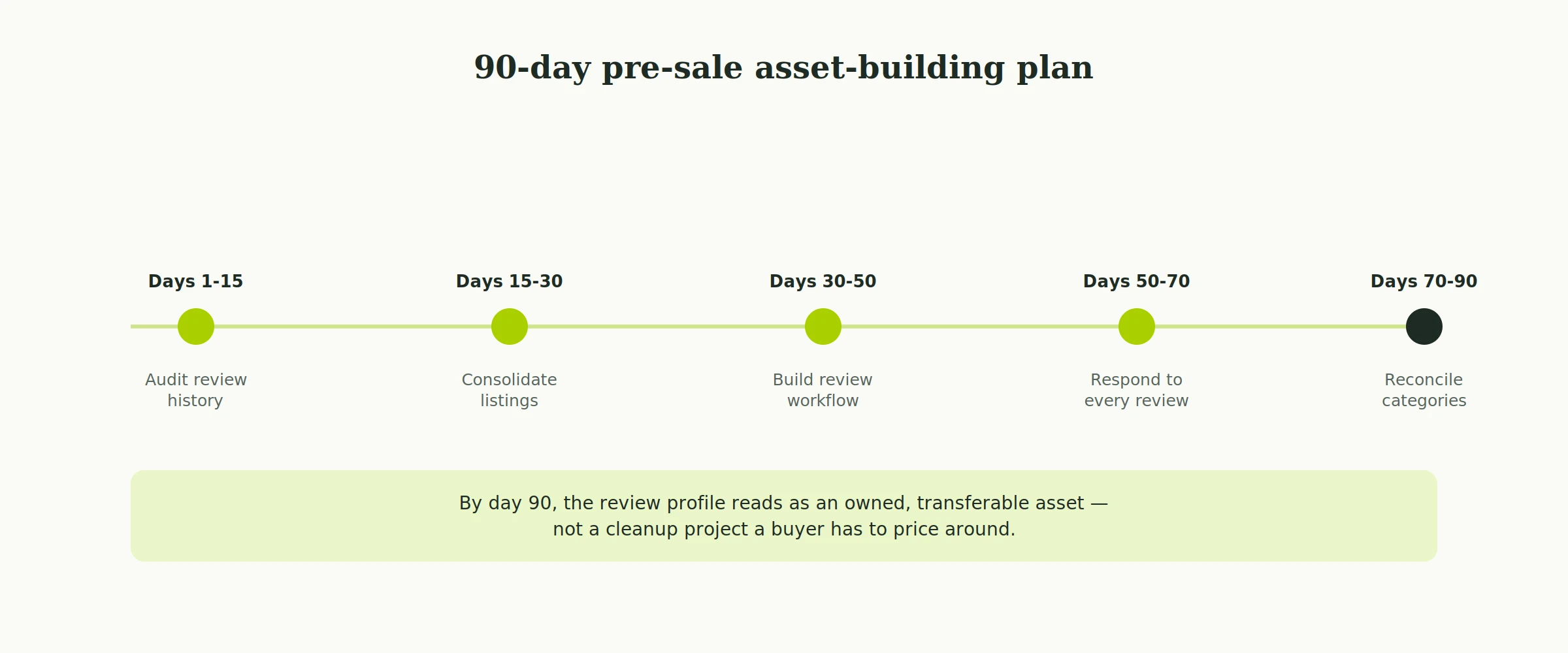
- Days 1–15: Audit review history for owner-name concentration; identify which technicians are under-represented and start requesting reviews specifically after their jobs.
- Days 15–30: Consolidate or remove duplicate/abandoned listings so the full history sits on one profile.
- Days 30–50: Put a review-request workflow in place tied to job completion, prompting customers to name the technician and the service performed.
- Days 50–70: Respond to every open review, especially negative ones, with a documented, non-defensive tone a future owner can also use.
- Days 70–90: Reconcile the category and services list against what's actually invoiced, so a buyer's cross-check matches cleanly.
Want your review profile priced in, not discounted?
This is exactly the kind of owned visibility we help plumbing, electrical, HVAC, and roofing companies build — whether you're selling next year or building for the long run.
Book Free CallFAQ
Do buyers actually check Google reviews during due diligence?
Increasingly, yes — often before a first meeting is even scheduled, as a fast way to gauge demand durability and reputational risk ahead of a deeper financial review.
Can a low review count still result in a strong sale price?
It can, if the reviews that exist are recent, specific, and spread across multiple staff members — but a thin review history generally invites more scrutiny, not less.
How far in advance should I start building this before selling?
As early as possible, ideally two to three years out. Review signals build credibility over time, and a sudden spike right before a sale can look manufactured to an experienced buyer.
Does responding to negative reviews really matter to a buyer?
Yes — it's read as a proxy for how the business handles problems generally, which matters more to a buyer than the existence of the occasional bad review itself.
Will fixing my Google Business Profile category change my valuation directly?
Not directly — but it improves the visibility and lead flow that produce the review volume and recency buyers ultimately price in, so it's part of the same asset-building process.
What's the single fastest way to improve my review profile before a sale?
Put a consistent review-request process in place tied to job completion, and make sure requests prompt customers to name the technician and the specific service performed.